
Can Vocabulary Learning
Be Fun?

By: Rena London National English Coordinator of Bnei Akiva

Vocabulary is the foundation of language learning. We can all agree that simply presenting students with long lists of words often leads to short term memorization instead of meaningful language acquisition. In order to help the students shift from receptive learning to productive use of the language, they must actively interact with the words through movement, games and collaboration. To support this process, here are five simple ideas that can make vocabulary learning more engaging and which can easily be implemented in the classroom.

1. Capsule Matching Activity
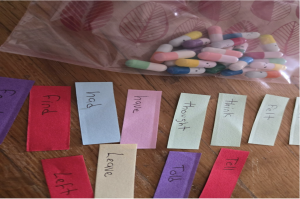
Using small plastic capsules (easily ordered online), place related vocabulary items in matching pairs—for example, a verb in one capsule and its past tense in another. Each student receives a capsule, opens it, and then searches the classroom to find their matching partner. This idea can be adapted in many ways: matching words to their meanings, words to example sentences, or collocations. The activity encourages students to move around, communicate, and actively think about vocabulary.
  1. Vocabulary Scratch Cards
    Scratch-off stickers can be used to create vocabulary “scratch cards.” Students scratch the card to reveal a word, meaning, or task. For example, they might uncover a word and then be asked to use it in a sentence or connect it to another word. The element of surprise adds excitement while still practicing the same language skills students would normally use.

3. Spin the Wheel
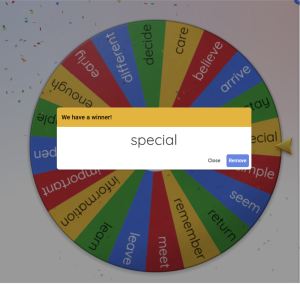
Instead of assigning words from a list, try using an online tool such as wheelofnames.com. Prepare a wheel with vocabulary words in advance. Students take turns spinning the wheel, and the word that appears becomes the focus of the activity—whether forming a sentence, explaining the meaning, or using it in a short dialogue. This simple tool adds variety and keeps students engaged.
  1. A “Physical Padlet”
    You can recreate the collaborative feel of Padlet without using technology. Place several posters with prompts around the classroom. Students receive sticky notes and move around the room responding to the prompts using the target vocabulary. For example, they might write a funny sentence using two new words. Students can read each other’s responses, react to them, and add their own ideas. The posters can remain on the wall for a few days to continue the learning.
  2. Gallery Walk
    Create a gallery of sentences or short texts displayed around the classroom, each with a missing vocabulary word. Students receive a list of the target vocabulary and walk around the room deciding which word fits each sentence. They write the number of the sentence next to the correct word on their answer sheet. This activity keeps students active while allowing for quick and easy assessment.

These activities show that vocabulary practice does not have to rely on memorizing lists. With a bit of creativity, we can transform vocabulary learning into an active and meaningful experience that encourages students to move, collaborate, and truly use the language. In this newsletter, you will also find inspiring ideas from our Bnei Akiva teachers, who have shared the creative and engaging activities they have implemented in their classrooms. Their work reminds us how much we can learn from one another. 

As we approach Pesach, I would like to thank all of you for your creativity, dedication, and willingness to share ideas with one another. Our students are lucky to have you! Wishing you and your families a joyful and meaningful holiday!


To the English Teachers of the Bnei Akiva School Network,

Shalom!

The Passover Seder is rich with customs, melodies, and foods — each community with its own cherished traditions. Yet sometimes, amid the abundance of (important!) customs, it is easy to lose sight of which Torah commandments we are fulfilling on this special night. In our times, during the Seder night we fulfill only two Torah commandments: eating Matzah and Maggid — the telling of our Exodus story.

Great care and effort are devoted to fulfilling the commandment of matzah, and it is equally worthy to invest the same devotion in the second commandment: the education of our children. This is the night we pass on our torch to the next generation — the night we teach them where we came from and where we are going to. This commandment is so central that it precedes the eating of matzah; and the very name of the text that guides the evening — the Haggadah, is derived from it.


How fortunate you are to be engaged in this precious Mitzva of educating the next generation, not just on one night, but throughout the entire year. Who better than us understand that English teachers carry a profound educational role — through the personal example we set, the way we respond to challenges in the classroom, and the attention we give to each individual student. But the English language itself also matters deeply. Time and again, we must nurture in our students an appreciation of the importance of this international language — a language through which knowledge can be shared, acquired, and carried forward, until the redemption of our people becomes the redemption of the entire world.

Wishing you a joyful Festival of Education!

Rabbi Dr. Yona Goodman
Head of the Education Administration of Bnei Akiva

A Cup of Confidence: Warm Hugs Before the Big Exam
Tali Edry, Yeshivat Bnei Akiva Kinor David
After accompanying my students since the 9th grade, seeing them head into their first English Module (Bagrut) was a milestone for all of us. I wanted to transform a stressful morning into a moment of connection and confidence.

The Initiative

Before the exam, we gathered for a "pre-game" cozy morning. I prepared a personal blessing in English for each student, alongside words of encouragement in Hebrew. To make it even more special, I asked parents to send a heartwarming message and a funny photo. We shared coffee and hot chocolate with whipped cream while I read a few words of inspiration to the class.

Voices from the Classroom

The emotional impact was far greater than I had imagined. One student looked around the room and said, "Wow, this feels like an end-of-the-year party, but I’m honestly not ready to say goodbye yet. "Another student shared,"I was so moved that I actually teared up reading what my parents wrote to me."Seeing them connect with their families' support right before the "big moment" was incredibly powerful.

The Impact

It shifted their mindset from "I have a test" to "I am supported." Starting the exam with a smile and a warm drink proved that while grades are important, the bond we build and their emotional well-being come first. Thankfully, the exam went smoothly, and they walked in feeling like winners before they even turned over the first page."
Purim Learning Stations: English in Action
Dorit Amosi, Yeshivat Bnei Akiva Shomron
Students participated in an engaging station-based activity, rotating in groups through seven carefully prepared stations. Each station offered a different interactive task related to the story of Purim. Activities included an escape room challenge, arranging sentences to retell the Megillah story, playing vocabulary bingo, preparing pancakes, karaoke and dancing, role-playing with costumes of characters from the Megillah, and watching a short video followed by a word search activity. Throughout the entire experience, students communicated and completed all tasks in English, creating a fun and immersive environment that strengthened their language skills while celebrating the holiday.
Bringing Grammar to Life Through Creative Characters
Simcha Cohen, Yeshivat Bnei Akiva Neve Herzog
In this activity, students create imaginative characters while practicing the Present Simple tense. Each student writes a short description of their character, including details such as the character’s name, where they live, their hobbies, and other personal information. After completing the description, students choose a voice (male or female), and the character “comes to life” by speaking the text the student has written. This engaging activity allows students to apply grammar in a creative context while strengthening their writing and speaking skills.
English with Simon
Simon Halevi, Yeshivat Bnei Akiva Kiryat Herzog
I have introduced an innovative approach to preparing students for Module C by creating a chatbot designed to support writing practice. The chatbot allows students to interact with prompts similar to those found on the Module C exam and receive immediate feedback as they draft and refine their responses. Through this interactive tool, students can practice organizing their ideas, expanding their answers, and improving their written expression in English. The chatbot provides a supportive environment where students can experiment with language, make mistakes, and revise their work, helping them build confidence and strengthen the writing skills required for success on the Module C exam.
Language Learning Through Community and Connection
Avigayil Buki, Ulpanat Bnei Akiva HaGolan
The 12th-grade students participated in a meaningful activity that combined English language practice with community engagement. They met with visitors from South Africa and had the opportunity to practice speaking English through authentic, real-life conversations. This interaction helped students build confidence and strengthen their communication skills in a natural and supportive setting. In addition, the students worked together to prepare sandwiches for soldiers, highlighting values such as teamwork, responsibility, and contributing to the community. The activity allowed students to experience language learning beyond the classroom while participating in an act of kindness and service. This initiative proved to be one of the most successful activities we have implemented. Students who typically hesitate to speak English were highly engaged and excited to interact with peers from abroad. The experience was so meaningful that several students continued to stay in touch with their new acquaintances, maintaining communication in English through ongoing messages and conversations.
Making Vocabulary Come Alive with AI
Ben Leon, Yeshivat Bnei Akiva Eli
With the help of AI tools, I create songs and short videos based on Band 2–3 vocabulary. These are uploaded to a YouTube channel and accompanied by links to interactive worksheets or printable PDFs for practice. The goal is to teach required vocabulary in a structured and engaging way through clean, meaningful content with positive messages. This approach helps students improve their listening comprehension while naturally expanding their vocabulary. Everyone is welcome to use the materials on my Youtube channel! Here is an example: "Modesty" Conversation – English Listening Practice

Dear Bnei Akiva Teachers,

Passover, the "Festival of Spring," marks the end of winter's rains and brings with it themes of rejuvenation and liberation, themes that are eternally relevant to the Jewish people. For high school teachers, however, this is also one of the most demanding times of the year, as the pressure of preparing students for Bagrut exams coincides with the hard work of preparing your homes for the holiday.

It is precisely for this reason that I want to take this opportunity to express my heartfelt appreciation for everything you do to promote English language learning in Israel. 

Your dedication and commitment do not go unnoticed.

I hope the Passover break gives you the time and space to breathe, reflect on the year so far, and recharge before the final push. As you do, I invite you to hold onto the bigger picture: our mission is not only to prepare students for exams, but to help them develop English skills, particularly productive skills, that will open doors and unlock opportunities for them throughout their lives.

Wishing you and your families a joyful holiday.

Bari Nirenberg

Chief Inspector for English in Junior High and High School

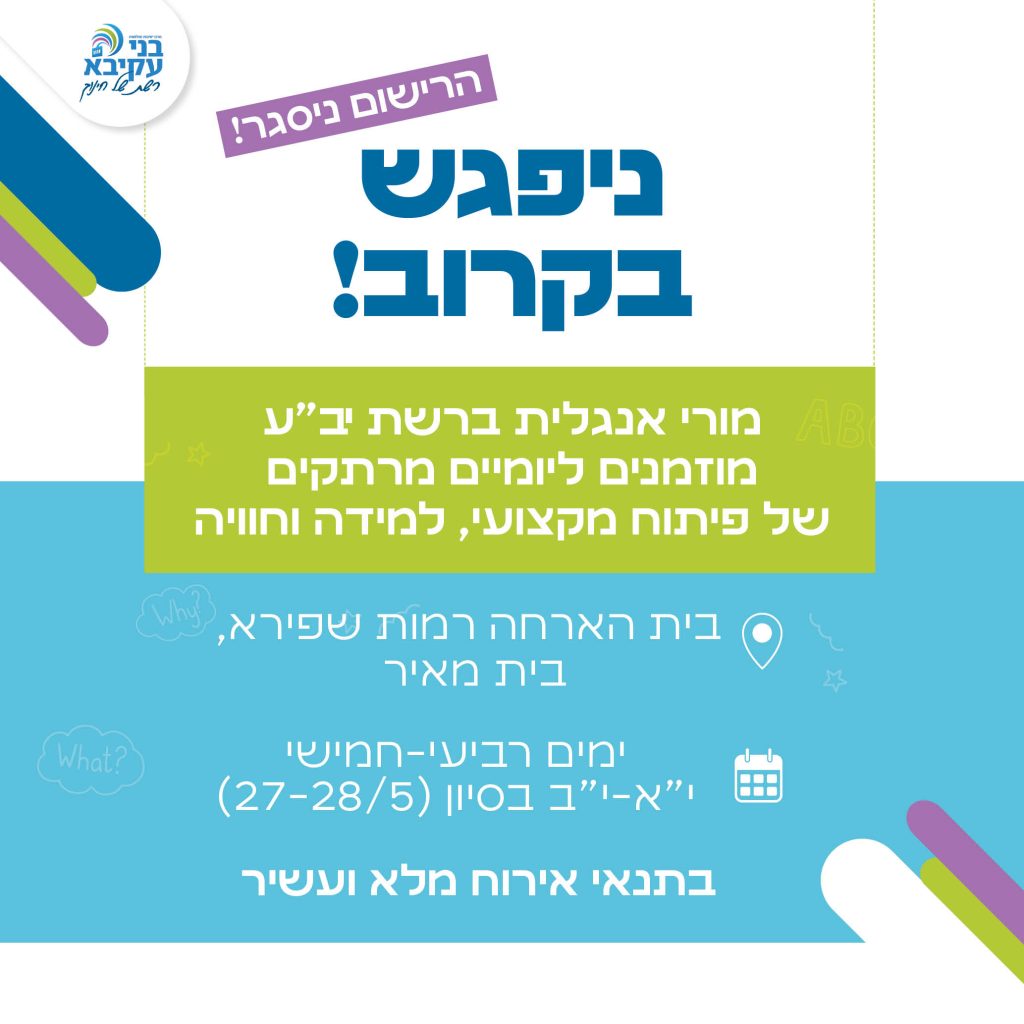
Summer Teacher Training

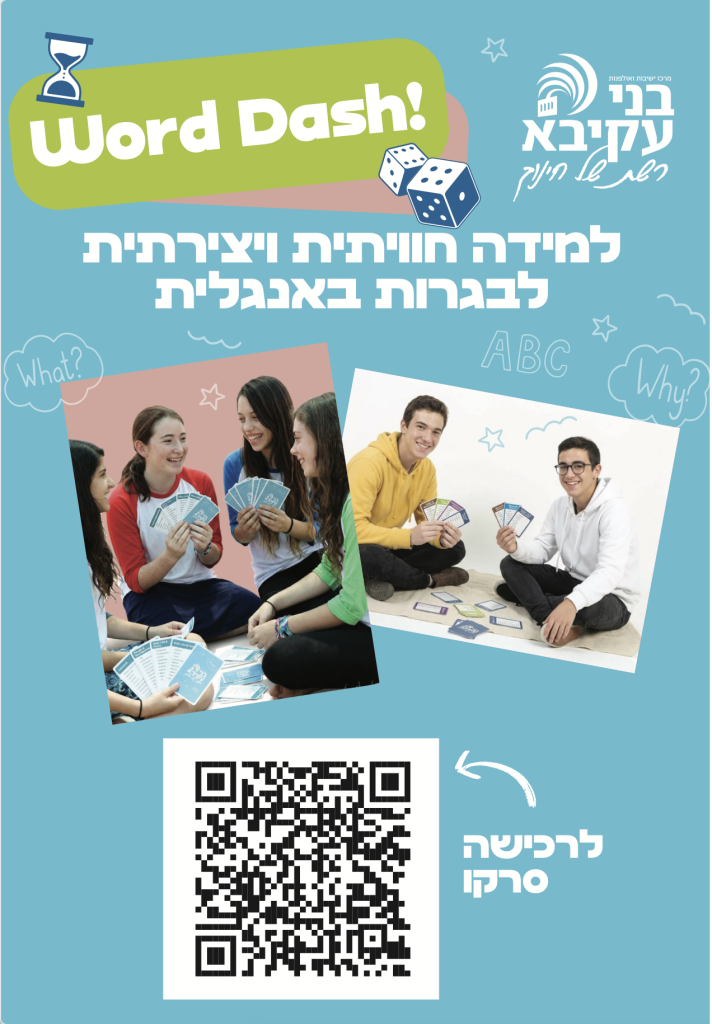
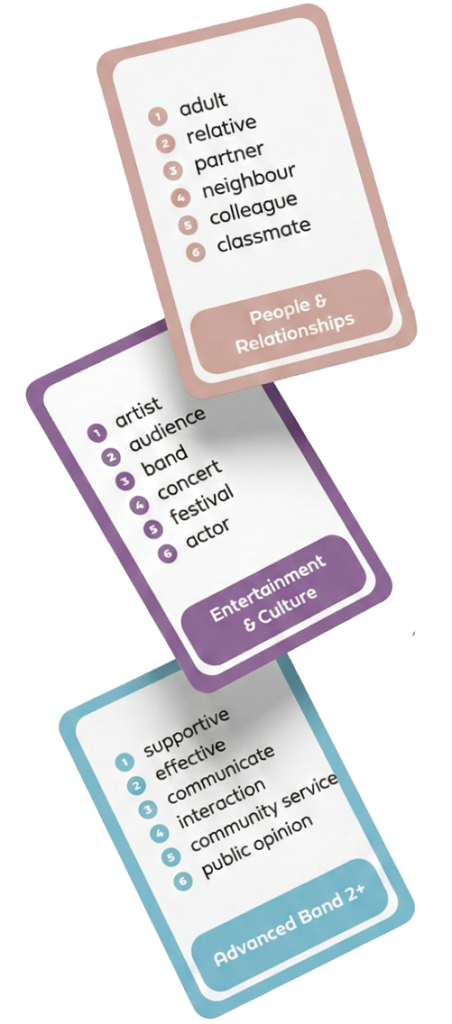
Word Dash!

The game encourages quick thinking, paraphrasing, and active use of vocabulary in context. By turning vocabulary practice into a dynamic and interactive challenge, Word Dash increases student engagement while developing confidence and flexibility in spoken English.

Word Dash is an engaging Alias-style speaking game designed to strengthen students’ vocabulary skills. Students work in pairs or small groups and roll a die to select a numbered word from a card. They must then describe the word without saying it directly, while their teammates try to guess it within a limited time.